Enes Akbuga, Ph.D. and Darin Kelberlau, Ph.D.
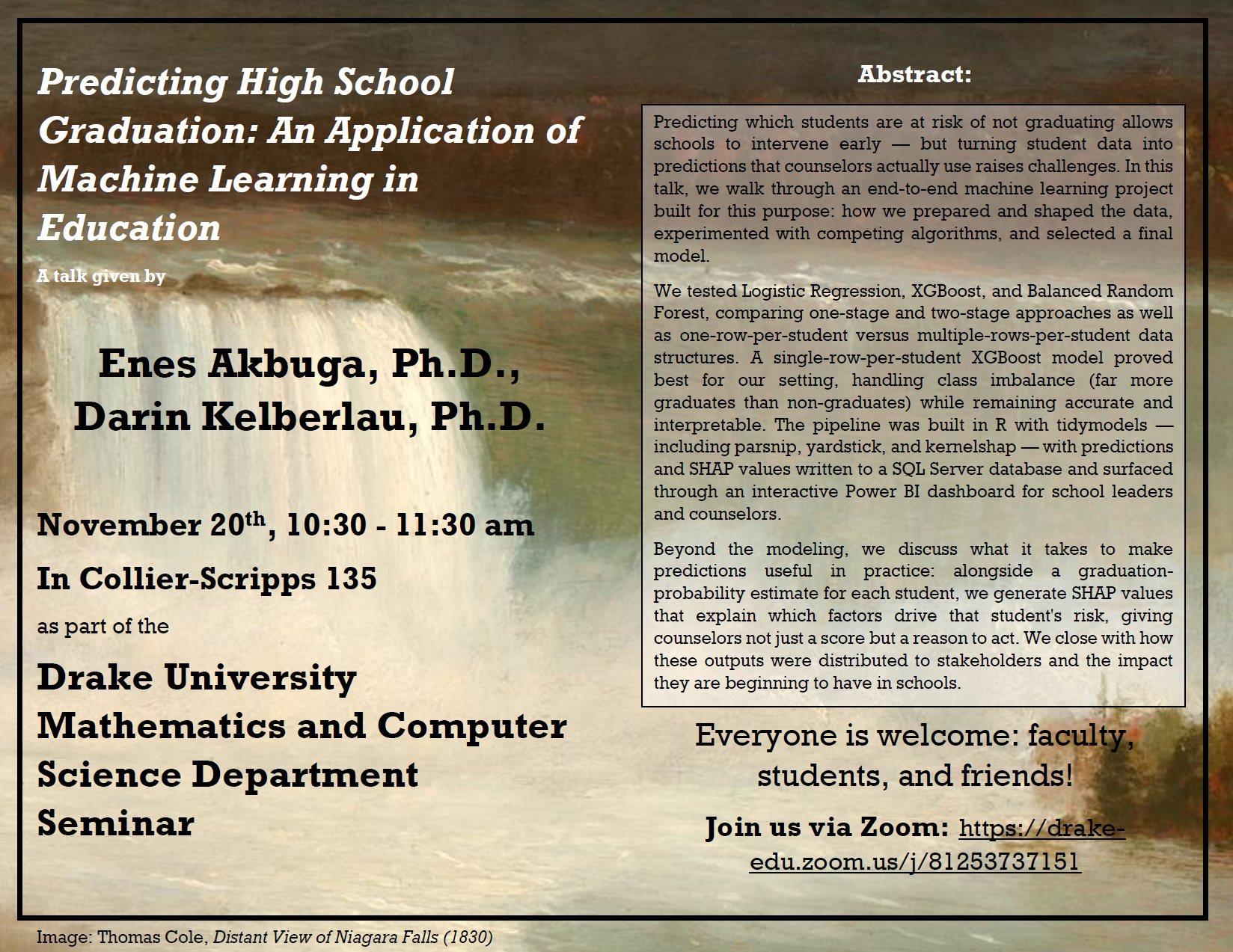
Enes Akbuga, Ph.D. and Darin Kelberlau, Ph.D.
Predicting High School Graduation: An Application of Machine Learning in Education
Join this talk via Zoom: Click to join
Predicting which students are at risk of not graduating allows schools to intervene early — but turning student data into predictions that counselors actually use raises challenges. In this talk, we walk through an end-to-end machine learning project built for this purpose: how we prepared and shaped the data, experimented with competing algorithms, and selected a final model. We tested Logistic Regression, XGBoost, and Balanced Random Forest, comparing one-stage and two-stage approaches as well as one-row-per-student versus multiple-rows-per-student data structures. A single-row-per-student XGBoost model proved best for our setting, handling class imbalance (far more graduates than non-graduates) while remaining accurate and interpretable. The pipeline was built in R with tidymodels — including parsnip, yardstick, and kernelshap — with predictions and SHAP values written to a SQL Server database and surfaced through an interactive Power BI dashboard for school leaders and counselors. Beyond the modeling, we discuss what it takes to make predictions useful in practice: alongside a graduation-probability estimate for each student, we generate SHAP values that explain which factors drive that student’s risk, giving counselors not just a score but a reason to act. We close with how these outputs were distributed to stakeholders and the impact they are beginning to have in schools.